A PCB cleaning machine removes defined contamination from printed circuit boards during electronics manufacturing. Depending on the production stage, it may clean dust from bare PCBs before solder paste printing or remove flux residue, loose solder balls and other process contamination from assembled PCBAs after soldering.
In global equipment sourcing, PCB cleaning machine is commonly used as a broad purchasing term. Buyers may use it when searching for bare-board cleaners, PCBA brush cleaners, batch washers or inline aqueous cleaning systems. The equipment must therefore be selected according to the actual board, contamination and production process rather than the search term alone.
DEZ separates these applications into two equipment categories:
PCBA cleaning machines for assembled boards after reflow, wave, selective or manual soldering
Table of Contents
PCB Cleaning Machine or PCBA Cleaning Machine?
The important distinction is the condition of the board when it enters the machine.
A PCB is the printed circuit board before components are assembled. At this stage, the main cleaning requirement is normally the removal of dust, fibres, hair, loose particles and static-attracted contamination before solder paste printing.
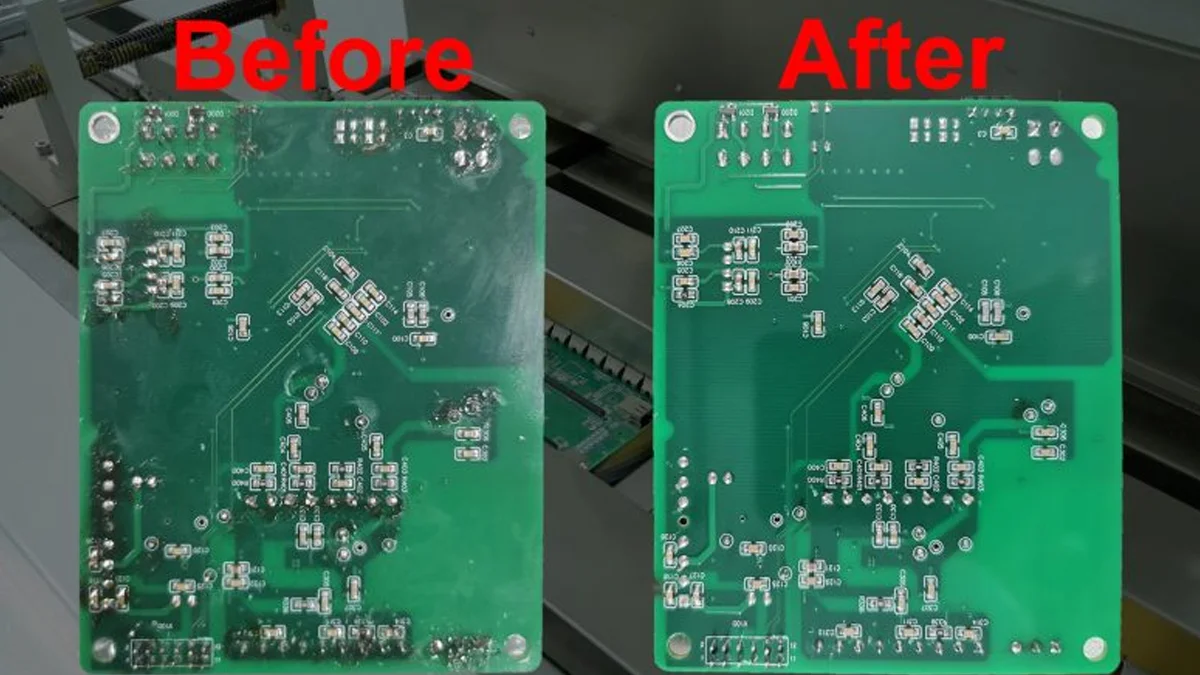
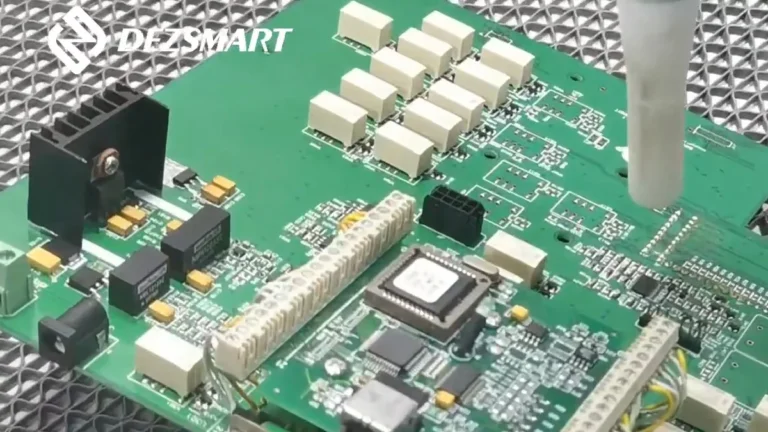
A PCBA is a printed circuit board assembly containing components and solder joints. Cleaning after assembly may target visible flux residue, ionic contamination, fingerprints, cleaning-agent residue, solder balls or other manufacturing contamination.
Both may be described as circuit-board cleaning in purchasing enquiries. However, they require different cleaning mechanisms.
Production condition
Main problem
Required process
Bare PCB before solder paste printing
Dust, fibres and loose particles on the board surface
Dry double-sided surface cleaning
Assembled PCBA after wave or selective soldering
Visible flux marks and loose solder balls on an accessible solder side
Single-sided brush cleaning
Mixed PCBA models after soldering
Flux residue requiring washing, rinsing and drying
Offline batch aqueous cleaning
Continuous PCBA production
Repeated washing, DI-water rinsing and drying
Inline aqueous cleaning
PCBA before conformal coating
Surface contamination that may affect coating application
Validated wash, rinse and drying process
A dry PCB surface cleaner cannot replace a post-solder PCBA washing machine. A brush cleaner also cannot reach every area beneath components or inside narrow gaps. The machine must match the location and type of contamination.
When Is a PCB Cleaning Machine Used?
Before solder paste printing
Bare PCBs can collect dust, fibres and packaging debris during storage, unpacking, handling and loading. Static charge can attract additional particles before the board reaches the printer.
A dry PCB surface cleaning machine is installed after the PCB loader and before the solder paste printer:
The cleaning system loosens particles, reduces static attraction and collects contamination rather than simply moving it to another part of the production area.
After wave or selective soldering
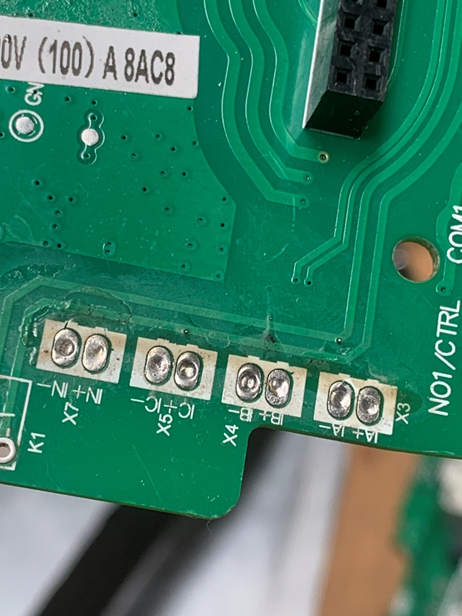
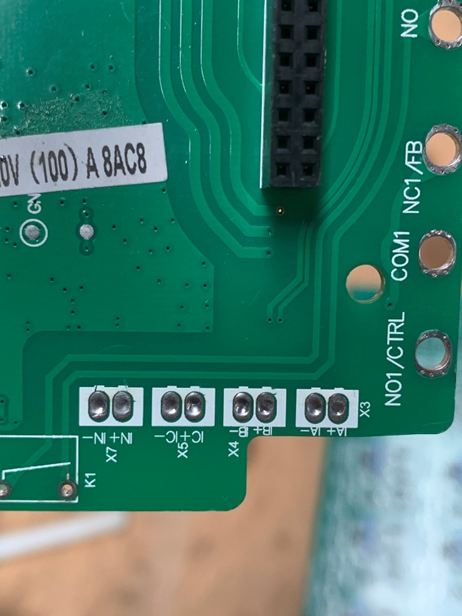
Wave and selective soldering can leave visible flux marks, loose solder balls or solder spatter on the accessible solder side of a PCBA.
When the contaminated surface is open to direct brush contact, a single-sided PCBA cleaning machine can apply a compatible cleaner and process the surface through controlled brushing and drying.
This route is intended for accessible surface contamination. Residue beneath low-standoff components or inside shielded areas may require a complete aqueous process or another validated cleaning method.
After reflow soldering
Reflowed assemblies may require cleaning when the flux process, product specification or downstream operation does not permit the remaining residue.
The decision depends on:
Solder paste and flux chemistry
Quantity and location of residue
Component and material compatibility
Electrical and environmental requirements
Customer cleanliness limits
Conformal-coating requirements
Inspection and testing requirements
A complete aqueous process normally includes chemical washing, DI-water rinsing and controlled drying.
Before conformal coating
Flux residue, fingerprints, oils, salts and cleaning-agent residue can interfere with coating wetting or adhesion. The PCBA must also be sufficiently dry before coating.
Cleaning before conformal coating should be treated as a controlled process. The coating, flux, cleaning chemistry, rinsing method, drying conditions and cleanliness test must be evaluated together.
When manual cleaning is inconsistent
Manual brushing and wiping depend on operator pressure, chemical quantity, brush direction, wiping material and cleaning time.
Automatic PCB cleaning equipment is used when the manufacturer needs:
PCBAs must move continuously through washing, rinsing and drying
DEZ-C753S for Bare-PCB Surface Cleaning
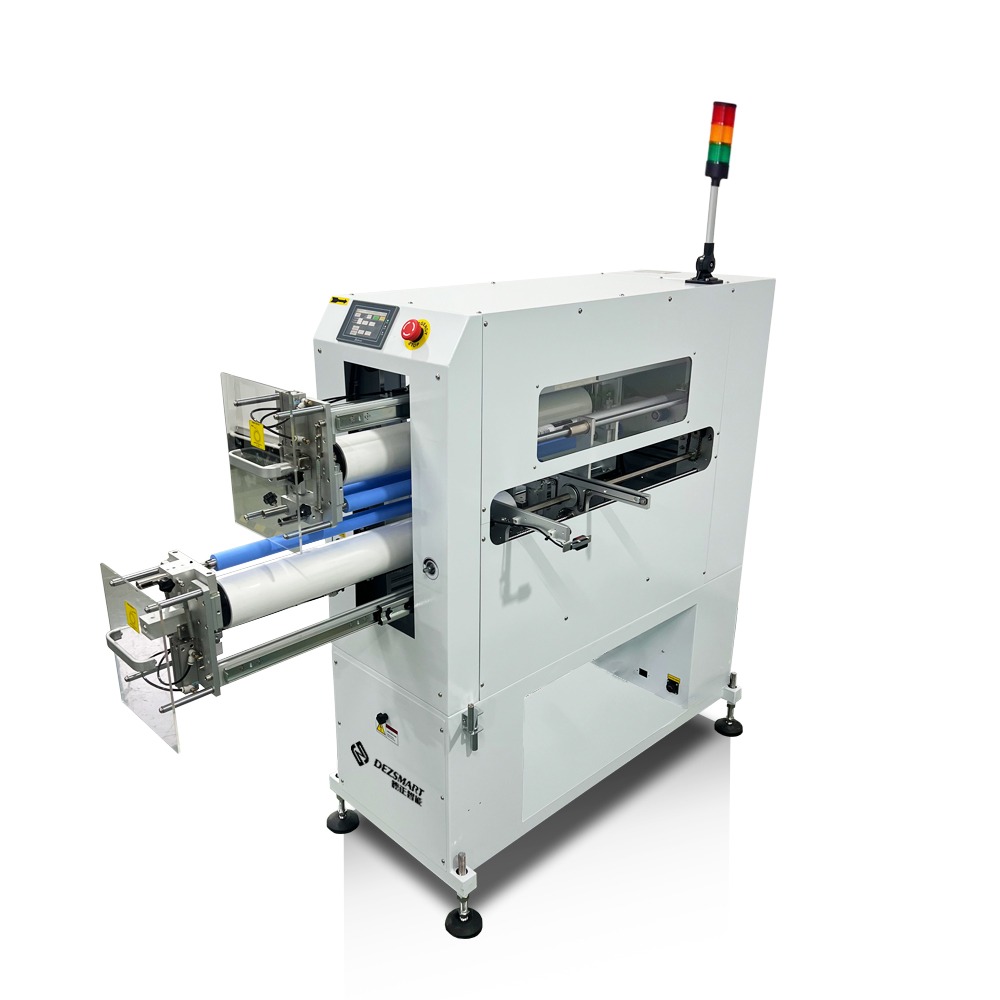
The DEZ-C753S is an automatic inline bare PCB cleaning machine for the stage before solder paste printing.
Three brushes loosen particles from the upper and lower board surfaces. Ionised air reduces static attraction, dual vacuum sections remove released contamination, and front and rear sticky rollers collect remaining particles.
It is suitable when the problem is dry surface contamination. It does not remove post-solder flux residue or measure ionic cleanliness.
Use the DEZ-C753S when:
The PCB is not yet populated
Dust or fibres are reaching the printer
Both board surfaces require cleaning
Manual air blowing does not collect the released particles
The cleaner must connect between the loader and printer
DEZ-C758 and DEZ-C760 for Accessible Solder-Side Residue
The DEZ-C758 and DEZ-C760 are brush-based PCBA cleaning machines. Both target an accessible solder-side surface rather than immersing or rinsing the complete assembly.
Choose DEZ-C758 when
The PCBA travels continuously through cleaner application, wet brushing, dry brushing and fan drying. It supports boards from 50 to 300 mm wide and components up to 135 mm high.
The DEZ-C758 is suitable for visible residue and loose solder balls that the brushes can reach directly.
Choose DEZ-C760 when
The PCBA can be held by the available board edge and moved through a rotary brush and two roller-brush stages.
The C760 supports PCBAs up to L300 × W300 mm and requires at least 1.5 mm of usable board edge. The main 360 mm rotary brush cleans the accessible solder side from multiple directions.
DEZ-C743 for High-Mix Batch Cleaning
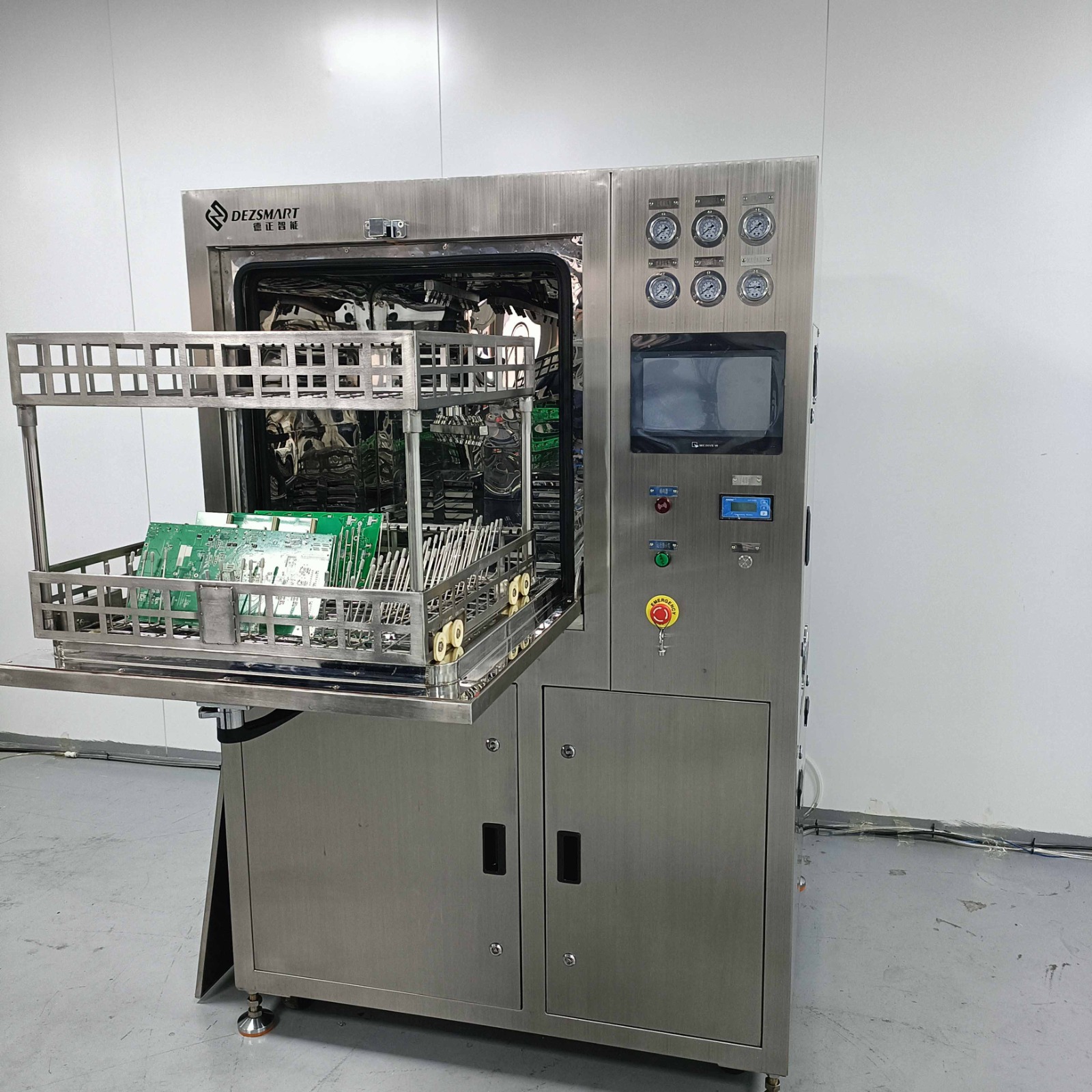
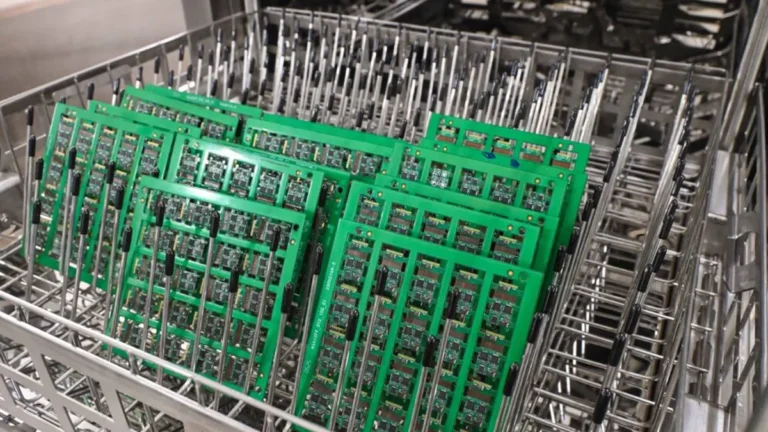
The DEZ-C743 is an offline batch PCB board washer for assembled boards. Multiple PCBAs are loaded into a double-layer basket and processed inside a sealed SUS304 chamber.
The process is:
Load → Spray Wash → DI-Water Rinse → Hot-Air Dry
It is suitable for:
High-mix production
Samples and small batches
Frequently changing PCBA models
SMT, THT and mixed-technology assemblies
Cleaning before compatible conformal-coating processes
Factories that require complete aqueous cleaning without a continuous inline system
“Offline” means stand-alone equipment. It does not mean that the wash, rinse and drying cycle is manual.
DEZ-C1360 for Continuous Inline Cleaning
The DEZ-C1360 is an inline aqueous PCB cleaning machine for assembled boards.
PCBAs travel on a 500 mm-wide SUS316 mesh conveyor through:
Chemical Spray Wash → DI-Water Rinse → Two Hot-Air Drying Zones
The machine supports compatible products from 50 to 500 mm wide, with customisation available. Conveyor speed is adjustable up to 1000 mm/min.
Choose an inline cleaning system when:
Cleaning is part of continuous production
Basket loading would interrupt material flow
Repeated recipes must be controlled through a PLC and touchscreen
The site can provide the required electrical power, DI water, exhaust and drainage
Washing, rinsing and drying must be completed in one conveyorised process
Inline does not simply mean automatic. It means that assemblies move continuously through separate process sections.
Why IPA Sometimes Leaves a Sticky or White Film
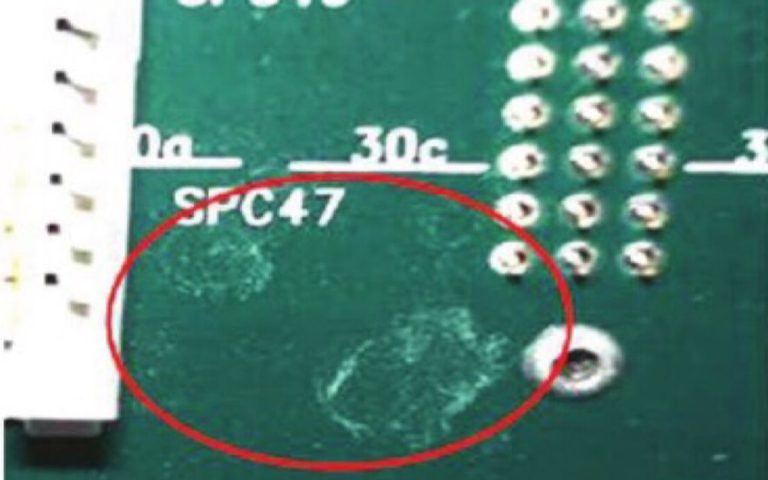
A common production and forum question is why a board remains sticky or develops a white film after cleaning with isopropyl alcohol.
IPA can mobilise compatible flux residue, but the contaminated liquid must still be removed from the board. If it is brushed across the surface and then allowed to evaporate, dissolved or suspended material can be redistributed and deposited elsewhere.
The result can be:
A thin sticky film
White residue after evaporation
Flux transported beneath components
Visible streaks
Different results between operators
The solution is not automatically to use more IPA. The process must consider flux compatibility, cleaning chemistry, mechanical action, removal of contaminated liquid, rinsing where required and complete drying.
For repeatable industrial production, this is one reason to replace uncontrolled wiping with a defined brush, batch or inline cleaning process.
How to Choose the Correct PCB Cleaning Machine
1. Identify the workpiece
Confirm whether the machine will process a bare PCB or an assembled PCBA.
2. Define the contamination
Specify dust, fibres, flux residue, ionic contamination, fingerprints, solder balls, solder paste or another known contaminant. “Dirty PCB” is not enough for process selection.
3. Locate the contamination
Determine whether it is on:
Both sides of a bare board
One accessible solder-side surface
The complete PCBA
Areas beneath low-standoff components
Connectors or shielded locations
4. Confirm whether brush contact is acceptable
Brush cleaning requires physical access and compatible component, lead and board-edge geometry.
5. Choose batch or inline production
Use batch cleaning for high-mix or changing production. Use inline cleaning when boards must pass continuously through separate wash, rinse and drying sections.
6. Define the cleanliness requirement
Visual cleanliness does not prove an ionic-contamination level.
Depending on the product requirement, evaluation may include:
Visual inspection
ROSE testing
Ion chromatography
Surface Insulation Resistance testing
Coating-adhesion testing
Customer-specific acceptance criteria
7. Check chemistry and material compatibility
Provide the manufacturer with the flux, solder paste, cleaning chemistry, component materials, coatings, labels and sensitive devices used on the assembly.
8. Confirm factory utilities
Global projects must confirm local:
Voltage and frequency
Compressed-air pressure
DI-water quality and flow
Exhaust capacity
Drainage and wastewater handling
Conveyor direction
Fixed rail edge
Production-line height
Available installation space
How Should Cleaning Results Be Verified?
A successful process must be verified against the reason for cleaning.
Requirement
Suitable verification
Remove visible dust or fibres
Controlled visual inspection
Remove visible flux marks or solder balls
Magnified visual inspection
Control ionic contamination
Defined ionic-cleanliness test
Prepare a PCBA for coating
Cleanliness, dryness and coating-adhesion evaluation
Stabilise an automatic process
Recorded chemistry, time, temperature, pressure, speed and loading
Qualify a new machine
Sample testing using representative PCB or PCBA assemblies
A before-and-after photograph can demonstrate visible change. It cannot establish an ionic-contamination value or guarantee long-term reliability.
Frequently Asked Questions
Does no-clean flux ever need to be removed?
Yes. Cleaning may be required when residue affects coating, inspection, appearance, high-impedance circuits or customer cleanliness requirements. “No-clean” does not mean that cleaning is prohibited or never necessary.
Can DI water remove flux by itself?
DI water is primarily used to rinse dissolved contamination and remaining cleaning agent after washing. It does not replace suitable cleaning chemistry when the flux is not water-soluble.
Should I choose a batch or inline cleaning machine?
Choose batch cleaning for high-mix, small- to medium-volume production or frequent model changes. Choose inline cleaning when PCBAs must move continuously through washing, rinsing and drying.
Can brush cleaning remove residue beneath components?
Not reliably. Brush systems target accessible surfaces. Residue beneath low-standoff components requires a process with suitable chemistry, liquid access, rinsing and drying.
What information does DEZ need before recommending a machine?
Send DEZ your board dimensions, contamination details, flux information, production volume and required cleaning result. Representative PCB and PCBA samples can be evaluated before the final machine configuration is selected.