A placement nozzle may look clean from the outside while contamination remains inside its narrow suction passage. When the internal bore becomes restricted, airflow decreases and the pick-and-place machine may experience low-vacuum alarms, repeated pickup attempts, mispicks or components dropping during movement.
For this sample test, three contaminated SMT nozzles were cleaned and inspected under a microscope. The purpose was to determine whether automatic cleaning could remove the visible deposits without inserting a needle or metal wire into the nozzle opening.
The samples were processed using an automatic SMT nozzle cleaning machine. The photographs below compare each nozzle bore before and after cleaning.
The Cleaning Problem
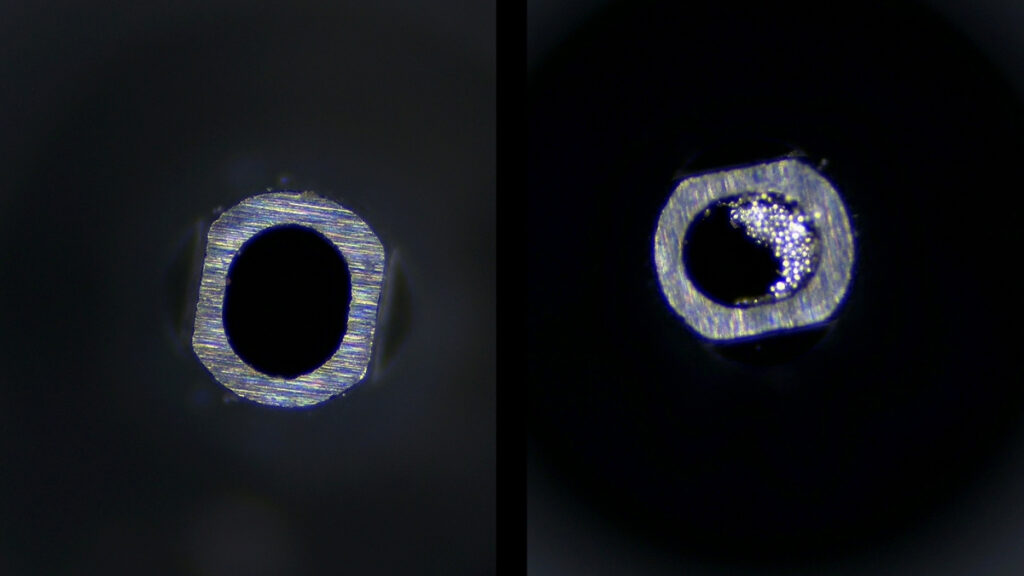
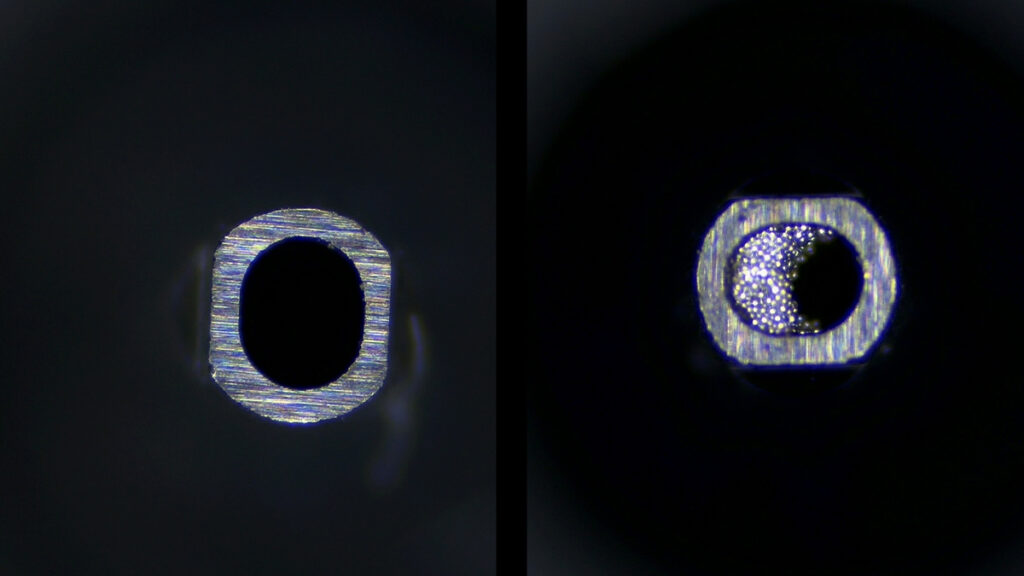
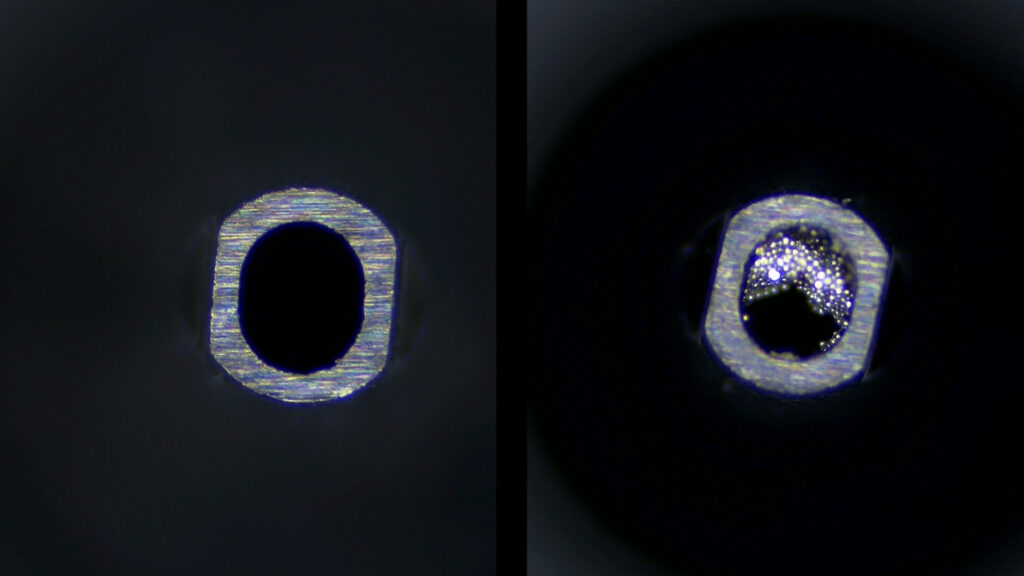
The microscope images taken before cleaning show reflective deposits covering part of each nozzle’s internal opening.
Although the precise composition of the contamination cannot be confirmed from photographs alone, the deposits were severe enough to reduce the available airflow path. In production, this type of restriction can lead to:
Reduced vacuum pickup performance
Repeated component pickup attempts
Components dropping during high-speed movement
Intermittent placement alarms
Unnecessary nozzle replacement
Incorrect diagnosis of a placement-head or vacuum-system fault
Fine nozzle openings are difficult to clean manually. Inserting needles, drill bits or metal wires may scratch the internal surface, enlarge the opening or deform the nozzle tip.
Sample 1: Heavy Deposit on One Side of the Nozzle Bore
Before cleaning: A large crescent-shaped deposit covered a substantial part of the internal passage. Only part of the suction opening remained unobstructed.
After cleaning: The visible deposit was removed, leaving a clear and continuous internal opening. No manual tool was inserted into the bore during the cleaning process.
Sample 2: Partial Internal Passage Blockage
The second nozzle showed a smaller but still significant deposit attached to one side of the bore.
Before cleaning, the obstruction reduced the effective opening and could have restricted airflow through the nozzle. After cleaning, the internal passage appeared open under microscope inspection, with no comparable deposit remaining in the photographed area.
This example is important because a partially blocked nozzle may still pick up some components. However, the available vacuum may be less stable during rapid acceleration and placement-head movement, resulting in intermittent rather than continuous faults.
Sample 3: Dense Contamination Inside the Opening
The third sample contained a dense group of reflective particles covering the lower portion of the nozzle opening.
After automatic cleaning, the photographed passage was visibly clear. The comparison demonstrates why external inspection alone is insufficient: contamination can accumulate inside the suction path even when the nozzle body does not appear heavily contaminated.
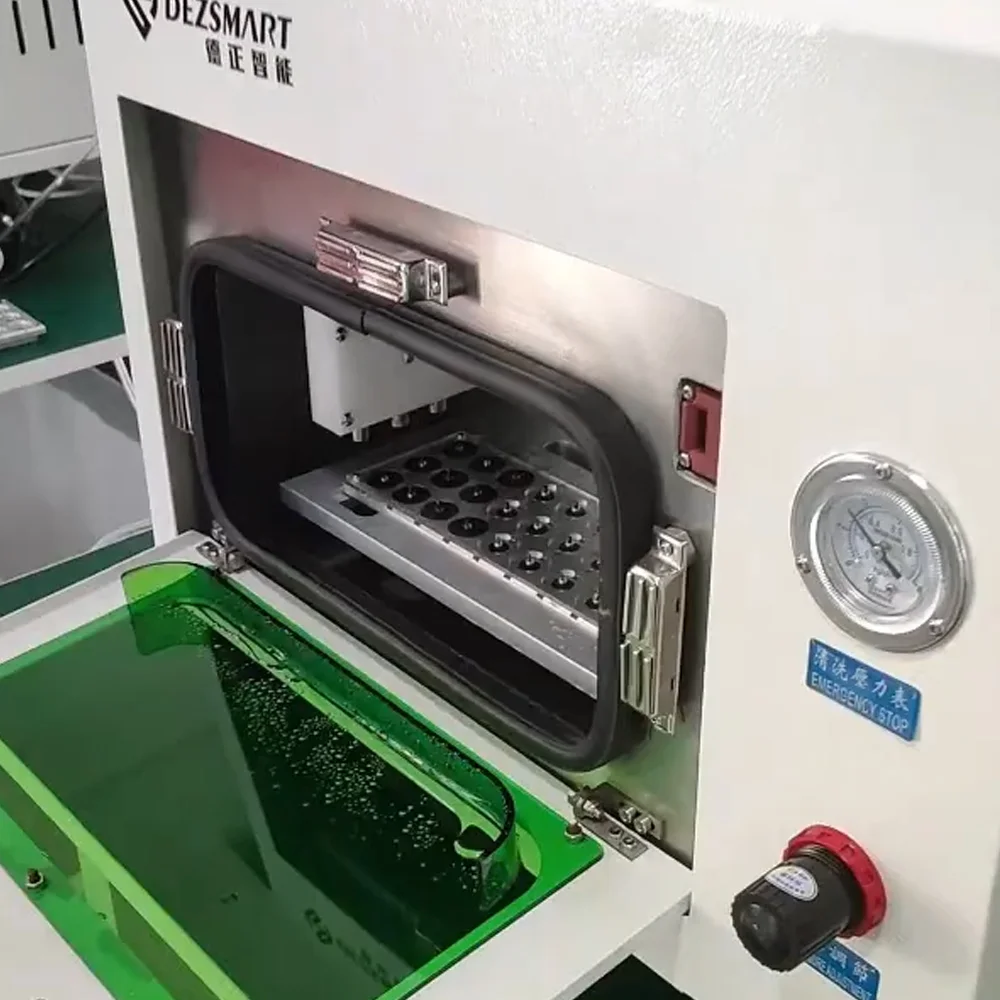
The machine uses controlled industrial-purified-water jets and compressed air to remove compatible deposits from the internal and external surfaces of SMT placement nozzles. Its standard tray holds up to 30 compatible nozzles, with three cleaning jets processing ten rows sequentially.
This method cleans narrow suction passages without inserting a solid cleaning tool into the nozzle opening. It is suitable for routine maintenance of compatible precision nozzles, including nozzles used for small-component placement.
Sample Test Result
Microscope inspection produced the following visible results:
Deposits were removed from all three photographed nozzle openings.
The previously restricted internal passages appeared clear after cleaning.
The process reached contamination located inside the nozzle bore.
No needle or metal wire was required to open the passage.
The cleaned samples were suitable for subsequent drying, inspection and vacuum verification.
The before-and-after images confirm removal of the visible obstruction. However, microscope appearance alone does not provide a numerical vacuum measurement.
Before returning a cleaned nozzle to the pick-and-place machine, it should be completely dried and checked for:
Vacuum pickup performance
Nozzle-tip wear or deformation
Cracks, chips or coating damage
Correct installation in the nozzle holder
Condition of the O-ring, filter and placement-head vacuum path
Automatic cleaning removes compatible contamination, but it cannot repair a worn, bent, cracked or mechanically damaged nozzle. If vacuum remains weak after the nozzle has been cleaned, dried and correctly installed, the remaining vacuum path and placement head should be inspected.
When Is This Cleaning Process Recommended?
The DEZ-C700 is suitable when:
Low-vacuum or pickup faults follow the nozzle when it is moved between compatible placement heads
Nozzle openings contain visible dust or deposits
Small nozzles are difficult to clean safely by hand
Used nozzles need to be cleaned before returning to storage
A factory wants standardized batch cleaning instead of manual needle cleaning
Representative nozzle samples must be tested before selecting equipment
Cleaning intervals should be based on nozzle usage, contamination level, component type and pickup data rather than a fixed schedule.
Send Your Nozzles for a Cleaning Test
Different nozzle brands and models can have different body dimensions, mounting structures and internal passages. Tray compatibility should therefore be confirmed before equipment selection.
Send DEZ the nozzle brand, model, dimensions, photographs and representative contaminated samples. We can evaluate tray compatibility, perform a cleaning test and document the condition before and after cleaning.
Request an SMT nozzle cleaning test and include the current pickup problem, nozzle quantity and component sizes used on your production line.