Dry Ice Blasting Machine for Electronics Manufacturing
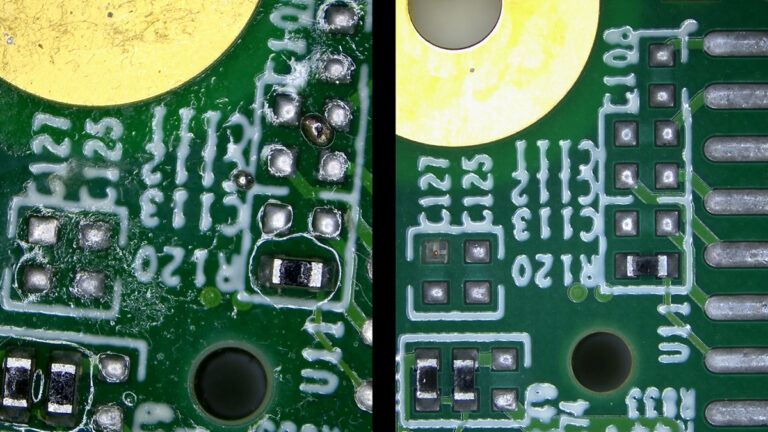
Dry ice blasting removes accessible flux, rosin and production residue from PCBAs and electronic parts without water, rinsing or cleaning-agent residue.
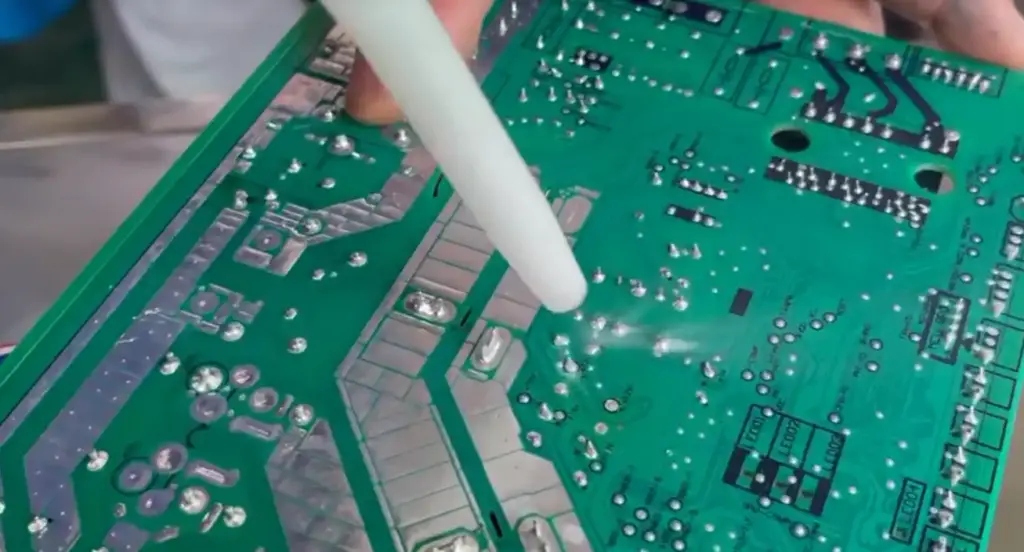
A dry ice blasting machine uses compressed air to accelerate solid carbon dioxide particles toward flux, rosin and other production residue on PCBAs and electronic parts.
Particle impact and rapid cooling weaken the bond between the residue and the underlying surface. The dry ice then sublimates into carbon dioxide gas, creating a local lifting effect that separates the brittle residue from the board.
Because no water or liquid cleaning agent is introduced, the assembly normally requires no rinsing or separate hot-air drying. This makes dry ice cleaning machines suitable for water-sensitive products, local rework areas and production processes that need to avoid liquid cleaning.
Table of Contents
How Dry Ice Removes Flux and Rosin
Dry ice cleaning combines three actions: particle impact, rapid cooling and sublimation.
Compressed air first accelerates the dry ice through a selected nozzle. When the particles strike the contaminated area, their kinetic energy begins to break the bond between the residue and the surface.
The low temperature makes compatible rosin, flux and hardened production deposits more brittle. Dry ice particles entering accessible cracks, openings and surface gaps then sublimate rapidly. The resulting carbon dioxide gas expands by several hundred times and helps lift the loosened contamination away.
The dry ice itself does not remain on the PCBA. Only the removed flux, rosin, dust or other contamination needs to be extracted or collected.
Cleaning Without Brushes or Liquid Chemicals
Dry ice blasting is a physical cleaning process, but it does not use a brush, wiping cloth or scraping tool against the PCB.
This avoids the repeated mechanical contact associated with manual brushing. It also prevents cleaning liquid from being carried into connectors, openings or water-sensitive electronic structures.
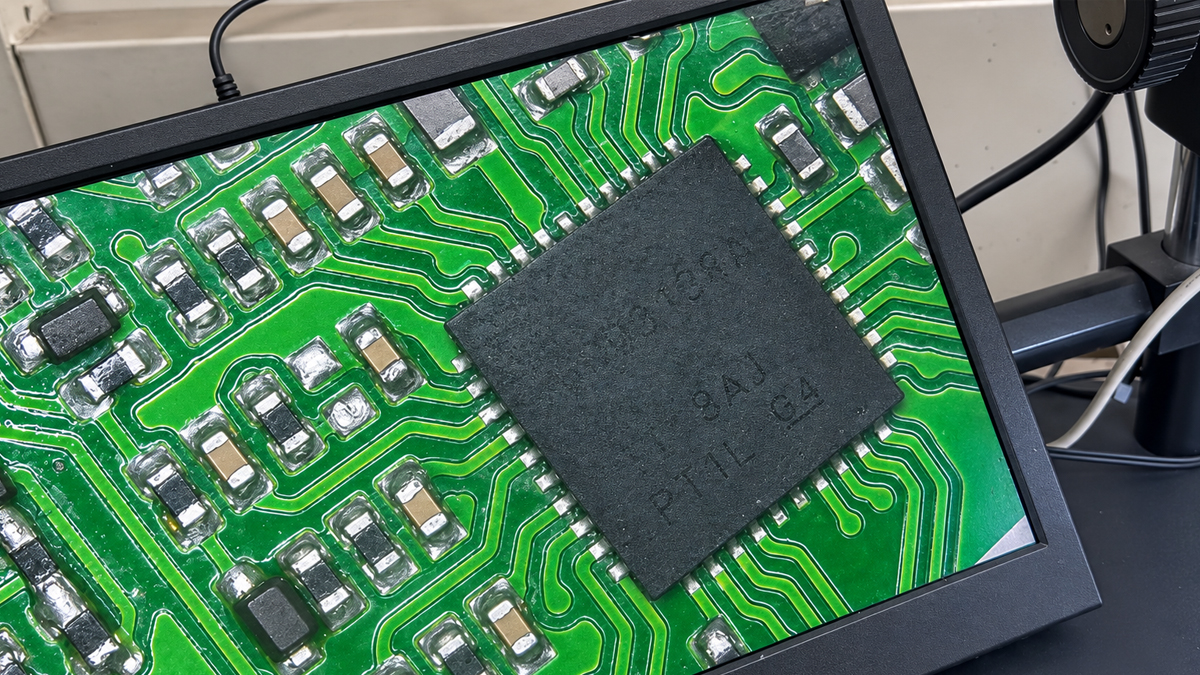
The process can remove accessible residue around solder joints, component leads, connectors, terminals and repaired areas. Focused nozzles can also reach suitable holes and surface gaps, provided that the spray path is not blocked.
It should not be assumed that dry ice can clean underneath every low-clearance component. Residue beneath BGA, QFN, shields or tightly mounted connectors may remain inaccessible when the particles cannot reach it directly.
Electronics Cleaning Applications
Workpiece or area
Typical cleaning requirement
Process consideration
PCBA after soldering
Accessible flux and rosin around solder joints, leads and connectors
Match pressure, nozzle and distance to the components
BGA or component rework area
Local flux, dust and loose particles after repair
Direct the jet only at the repaired area
Precision sensor
Residue around the housing, terminals or external structure
Protect glass windows and sensitive openings
Electronic module
Dust, carbon deposits and compatible production residue
Confirm compatibility with plastics, labels and coatings
Soldering fixture or pallet
Flux, resin and deposits on accessible surfaces
Higher cleaning force may be possible after testing
Production mould or machine part
Oil, grease, resin and carbonised deposits
Select the nozzle according to the surface and contamination
Dry ice cleaning is particularly useful when the contamination is concentrated in an accessible area and the product should not enter a complete aqueous wash, rinse and drying process.
Protecting Sensor Windows and Delicate Components
Dry ice cleaning is not automatically safe for every electronic product.
A precision sensor may contain a glass window, optical surface, microphone opening, membrane, exposed wire or mechanically sensitive element. These areas should not receive an uncontrolled direct spray.
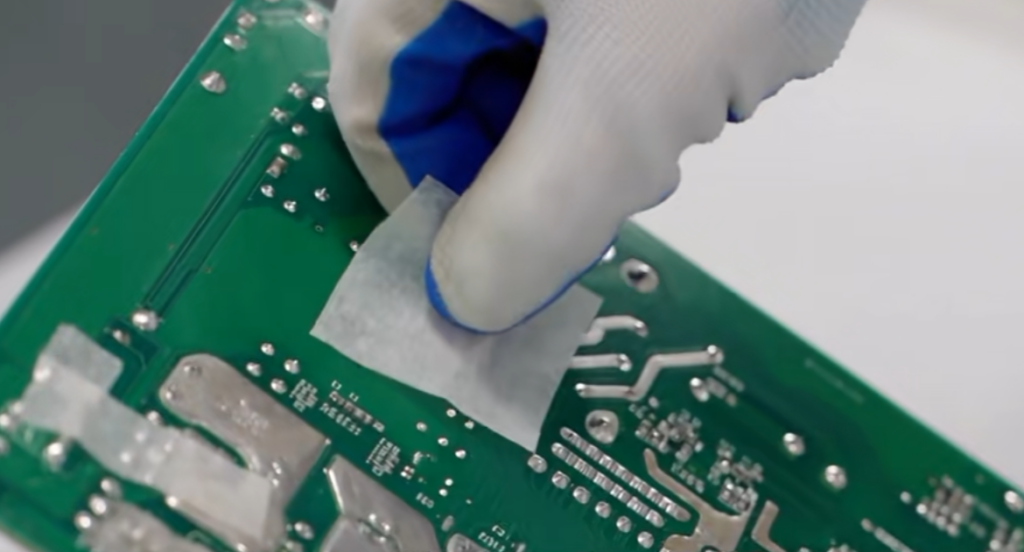
For a sensor with a glass observation window, cover the window with compatible high-temperature protective tape and direct the nozzle away from its front surface. Confirm that the tape adhesive will not leave residue or react with the product.
The same precaution applies to:
Unprotected labels and printed markings
Flexible circuits and thin wires
Soft conformal coatings
Exposed membranes and seals
Delicate connectors and moving structures
Pressure, dry ice feed, nozzle shape, spray angle, working distance and exposure time determine the actual cleaning force. A sample test is therefore necessary before production settings are approved.
Will Dry Ice Damage the PCB?
A correctly developed process can remove compatible residue without scratching or mechanically brushing the PCB surface. However, “no damage” should not be treated as an unconditional machine claim.
Excessive pressure, an unsuitable nozzle or a working distance that is too short may affect fragile components, loose labels, thin coatings or mechanically weak structures. The surface can also become very cold, creating a condensation risk in humid production environments.
After cleaning, allow the assembly to return to a stable temperature before electrical testing, conformal coating, bonding or packaging.
Dry ice cleaning also does not automatically prove ionic cleanliness. A board may look clean while soluble ionic contamination remains beneath components or between conductors. When ionic-cleanliness limits are specified, verify the result using the required test method or use a validated PCBA flux and ionic contamination cleaning process.
No Water Does Not Mean No Waste
Dry ice sublimates and leaves no blasting media on the workpiece. This eliminates spent water, cleaning-agent residue and a separate rinse stage from the cleaning process.
The contamination removed from the assembly does not disappear. Flux particles, dust, coating fragments and other deposits must still be captured by extraction or collected from the cleaning area.
The process also releases carbon dioxide gas. Suitable ventilation, local extraction and CO₂ monitoring are required, especially in enclosed rooms or low-level working areas.
Selecting the Machine Format
The machine format should match how the factory handles its products.
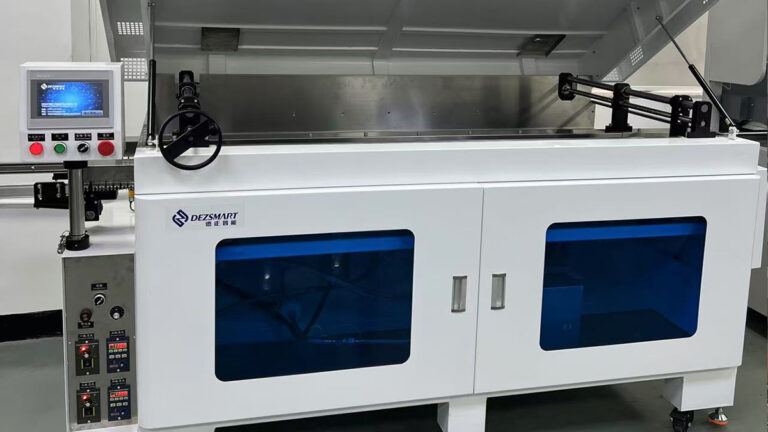
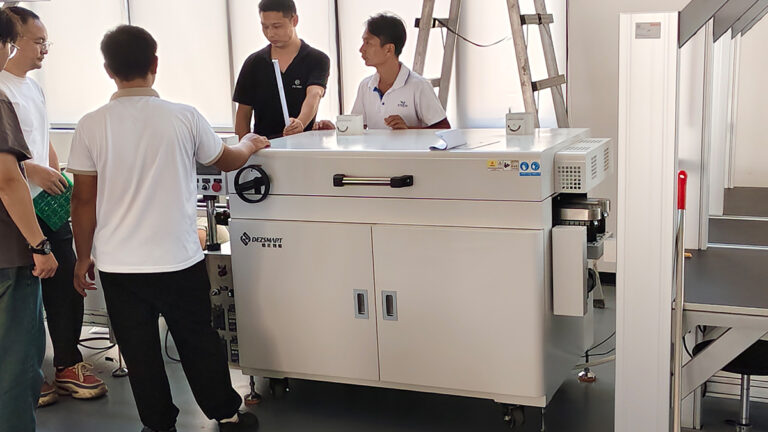
The DEZ-C7310 PCBA dry ice cleaning machine provides a dedicated workstation for PCBA cleaning and rework areas. Its adjustable dry ice feed, spray pressure and interchangeable nozzles support targeted cleaning of different assemblies and contamination levels.
The DEZ-C7320 inline dry ice cleaning machine is intended for repetitive cleaning integrated with a production line. It is suitable when PCBAs or electronic parts must move through a controlled waterless cleaning process at a defined cycle time.
Compressed-air capacity must be checked for every configuration. A compressor may show sufficient pressure but still lack the airflow required for continuous stable spraying.
Free Sample Cleaning Test
The cleaning result depends on the actual flux, residue thickness, PCB surface, component layout and sensitive structures.
Send DEZ a representative contaminated sample. We will evaluate the cleaning access, protect sensitive areas where necessary and test the nozzle, air pressure, dry ice feed, working distance and processing time.
For an inline project, also provide the minimum and maximum product dimensions, required cycle time, conveyor direction and production-line height.